About Mishkat
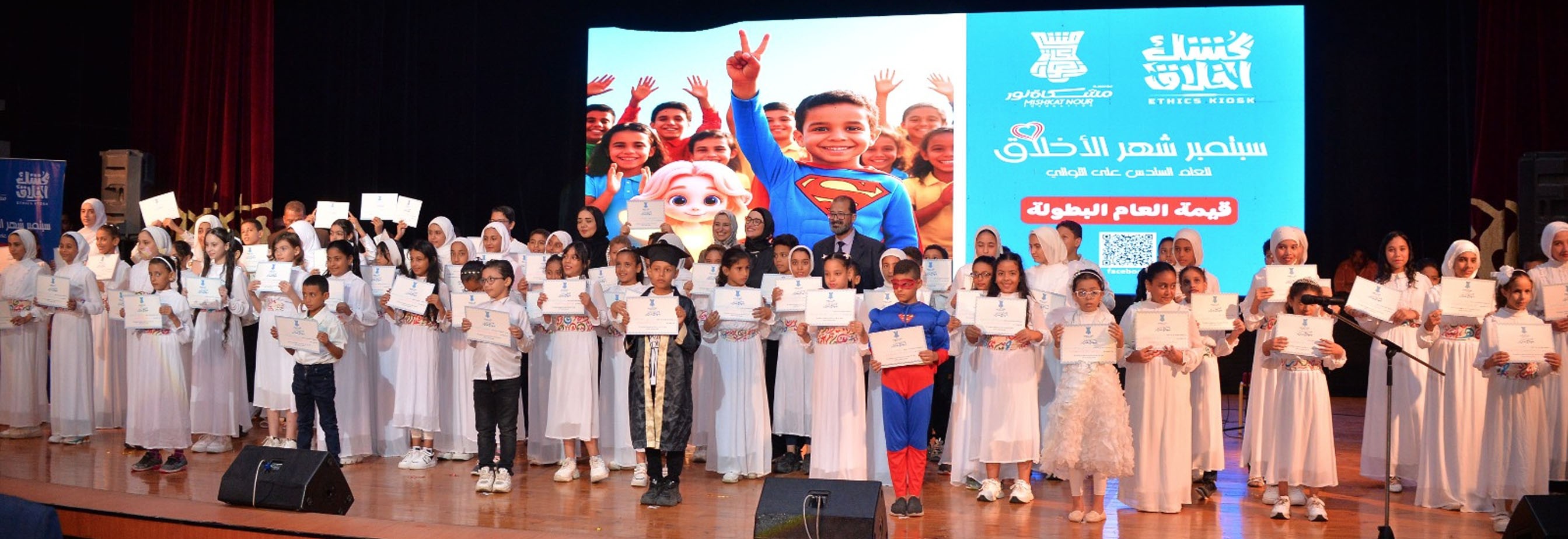
Mishkat Nour Foundation launched the innovative project “Ethics Kiosk” to redefine development work in Egypt. This project uniquely combines providing support with shaping positive behavior. Ethics Kiosk is built on 14 integrated programs and nearly 140 sub-programs, all designed to strengthen values, build human capacity, and achieve both sustainable development and healthy behavior.
Among these programs are Continuous Learning, Shattara, Sheltered Homes, Mishkat Kitchen, and The Compass. Each one is crafted to empower individuals and families, while fostering responsibility towards the environment and a dignified life.
Tangible Achievements:
In Sohag, the project reached around 90 villages, offering hands-on training programs. Young people received ICDL and Mini-MBA courses, transforming from beneficiaries into active producers within their communities.
In Fayoum, the foundation renovated 20 rural homes in Youssef Al-Seddiq villages, improving roofs, flooring, plumbing, and painting, in addition to carpentry. Another 237 homes received roof coverage, while food aid was delivered to the most vulnerable areas.
In Assiut, Mishkat Nour revitalized Al-Masoudi Village, carrying out full renovations including roofs, plumbing, electricity, carpentry, plastering, and painting. In Dayrut alone, 22 houses were transformed into safe, healthy living spaces.
In Port Said, Mishkat Nour left a strong impact in areas such as Fatima Al-Zahraa, Old Labana, Sayeda Nafisa, and Al-Amal in Port Fouad. Efforts included urban renewal, infrastructure upgrades, and creating cleaner, more dignified environments. The foundation also established the Continuous Learning Center — a hub for knowledge, skills development, and family-oriented training programs.
Through Ethics Kiosk, these initiatives are delivered across some of the most vulnerable neighborhoods, aiming to improve quality of life, promote economic empowerment, and encourage positive behavior through active dialogue between civil society and the state.
Open to All:
The foundation provides a variety of activities accessible to everyone, including workshops in handicrafts (sewing, embroidery, crochet, drawing, tailoring), exhibitions and e-shops to showcase beneficiaries’ products, professional training in technology and management, youth empowerment, as well as cultural and artistic programs. Social and health support is also provided, from meal distribution to vaccination campaigns and early disease detection.
Mishkat Nour — where giving turns into real change.
At Mishkat Nour, we believe charity is not just about providing food or aid, but about a journey that uplifts souls and reshapes communities. Through Ethics Kiosk, we deliver programs that instill positive values, expand education, strengthen economic and health resilience, and even rebuild living dreams. From Sohag to Luxor, from Fayoum to Port Said — we reach hearts before we reach homes.
The Vision of Mishkat Nour Foundation
A global model that enhances ethics and transforms communities into sustainable environments through diverse programs and innovative technology that changes human behavior and the approach to charitable work.
Mission
We strive to improve human behavior and promote ethics through the «Ethics Kiosk» project and its integrated programs to provide innovative and sustainable solutions..
The Goals of Mishkat Nour Foundation
- Implementation of Behavior Modification Programs:
Utilizing «Ethics Kiosk» to generalize the concept of self and societal accountability.
- Behavioral Adjustment for Children:
Linking (educational, artistic, cultural, technological activities, and microeconomic empowerment) to
behavior improvement programs.
- Enhancing Ethical Standards within Families:
Connecting (developmental programs, social and medical assistance, and diverse economic empowerment
initiatives) to behavior improvement programs.
- Transforming Areas with Disorganized Behavior:
Developing such areas into exemplary communities in terms of ethics and development.
- Supporting Orphans:
Offering comprehensive programs in education, health, sports, arts, and entertainment within their family
environment through a unified digital map.
- Digitization of Charitable Work:
Linking (charitable performance, development efforts, and
administrative improvement) through an ERP system to enhance efficiency and transparency.
- Improving Local Community Performance:
Utilizing innovative and developed solutions to enhance the capabilities and performance of local communities.
- Active Participation in Tourism and Economic Development:
Promoting small and micro-enterprises as a national contribution
with a significant impact.
? Why Mishkat
1- A new goal has been added to the Sustainable Development Goals adopted by the United Nations, which is the goal of amending human behavior.
2- The first civil society institution that activated the principle of self- and community control Through the police program Community through community monitoring of the areas in which the institution operates and determining behaviors. The general public within these areas, and then developed programs that would deal with these behaviors. Highlighting the positive aspects and working to modify the negative aspects with the aim of transforming the negative elements within society. For effective positive elements within the community.
3-The first fruitful experience in establishing a successful partnership between civil society, executive leadership, and local authorities within the governorates in which the Foundation operates; this is done by raising the efficiency of the information infrastructure of the neighborhoods. Local and create a database of revenues, expenses, and administrative activities for each district.
4- Providing programs for the real application of human development.
5-It is the first successful experiment to network all executive state agencies within the governorates at the same time. Starting from the governorate, passing through the ministries’ directorates, and reaching the local neighborhoods, in addition to the security agencies and the military advisor’s office in the governorates.
6- Providing humanitarian and social assistance has not been an end in itself; rather, Mishkat Nour has linked humanitarian and social aid to modifying the individual’s behavior within his community, which many charitable and development institutions have neglected and which has led to the creation of unemployment and the dependence of individuals. To receive assistance without participating in improving the community condition and developing its resources.
7- The «Ethics Kiosk» project adopted by the Foundation was concerned with raising the level of morals. In addition to raising the level of» sustainable development rates», building people comes before building stones.
8- The Foundation has set new standards for society and has established a programme to create humane structures (individuals with positive impact) within communities that have the capacity, knowledge, and skills to create new human structures. Other within the community.
9-The first institution to provide national education for children in slum areas and the most needy areas through the school Foundational Ethics and also through the establishment of Mishkat Nour Modern Language School.
10- It is the first institution to enter into the task of improving the efficiency of informal areas, something that no civil society institution has done before it. It is the file that the state has dealt with alone over the past years.
11- Directing social workers to provide psychological support and behavior modification services within Target areas and communities.
12- The first institution to develop its programs in an integrated manner to serve the goal of linking human behavior to sustainable development within societies.
The Concept
Civil society works to raise development rates sustainable.
Reality
Civil society works primarily towards providing social assistance and establishing projects only.
(The individual is the main component in sustainable development)
Reducing Sustainable Development Rates
If the behavior is bad, it will result in it:
Unemployment, Bullying, Bad morals, bad behaviors, environmental deterioration, and educational.
Raising sustainable development rates
If the behavior is good, you will be rewarded for it:
Economic Empowerment,Healthy Awareness, better education, healthy behaviors, Improving the Environment, and Healthy Creation.
So the problem is behavioral?
The solution is an Ethics kiosk project to link social assistance to behavior.